What is the Sun, really?
The short answer
The Sun is a star, the closest one to Earth. It is a vast ball of glowing gas, mostly hydrogen with some helium, held together by its own gravity. It is not on fire, because fire needs air and space has none. It glows because it is extraordinarily hot: about 5,500C at the surface and 15 million degrees in the core.
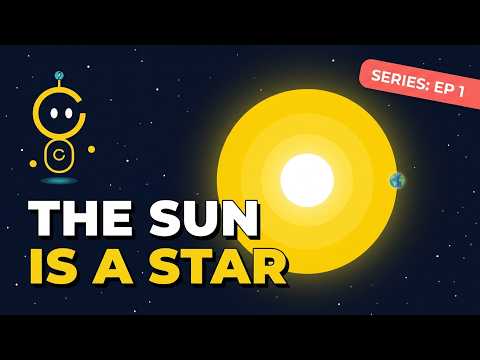
It is a star, and that is the whole answer
Every point of light you see on a clear night is a star, and every one of them is a sun to somebody. Ours is not special in any cosmic sense. It is average in size, average in temperature, average in age. What makes it feel special is proximity. The next nearest star is so far away that its light takes over four years to reach us. Ours takes eight minutes. That single difference is why one star warms your face and the rest are pinpricks.
The distance is hard to picture, so try a jet plane
The Sun sits about 150 million kilometres away. Numbers that large stop meaning anything, so convert them into something with a speed you know. A passenger jet flying flat out, never stopping to refuel, would need roughly twenty years to cover that distance. Light does it in eight minutes and twenty seconds. The gap between those two numbers tells you more about the scale of space than the kilometres ever will.
You could pour 1.3 million Earths inside it
The Sun is about 109 times wider than Earth, which sounds impressive but understates it badly. Width is one dimension; volume is three. Fill the Sun with Earths and you need around 1.3 million of them, with room left to rattle them about. This is worth being careful with, because the two numbers get confused constantly. 109 is the ratio of diameters. 1.3 million is the ratio of volumes. Both are correct, and they describe different things.
It cannot be on fire, and this is not a technicality
Fire is a chemical reaction between a fuel and oxygen. Space contains essentially no oxygen, so nothing up there can burn in the way a candle burns. The Sun glows for a different reason entirely: the gas is so hot that it radiates light, in the same way the filament inside an old light bulb glows without burning. Calling the Sun a ball of fire is not a harmless simplification. It points at the wrong physics and makes the real answer, fusion, harder to understand later.
Hot at the surface, almost unimaginable in the core
The visible surface runs at roughly 5,500C. For comparison, a domestic pizza oven reaches around 250C, so the Sun's surface is more than twenty times hotter. Then go inward. At the centre, crushed under the weight of everything above it, the temperature reaches about 15 million degrees. That is the engine room, and it is the only place in the Sun where energy is actually produced. Everything else, all the layers and light and warmth, is a consequence of what happens there.
Sources
Full transcript: What is the Sun? (Episode 1)
Look up on a clear dark night and you'll see thousands of tiny lights. Stars! They look like glitter, but every single one is a giant ball of light unbelievably far away. And here's the amazing part: one of them is very, very close.
In fact, you see it almost every day. It's the Sun! And that's our robot friend. He's coming along because today we're asking one giant question: What is the Sun, really?
Maybe it's a huge ball of fire, a giant lamp somebody switched on, a hot glowing rock? Good guesses! People wondered about this for thousands of years, but the real answer is stranger and much cooler. There's only one way to find out.
Let's go look! 3... 2... 1...
and up! Past the clouds, past the sky, out into space! Look back. That blue marble is home.
Everyone you've ever met lives on that little dot. Bye for now, Earth! First surprise: the Sun is far. About 150 million kilometers away.
If you tried to fly there in a jet plane, you'd better pack snacks! You'd be flying for around 20 years. Good thing Watt knows a shortcut! Second surprise: the Sun is big.
Really, really big. See that tiny blue dot? That's Earth, a whole planet. If the Sun were a giant empty ball, you could pour in 1,300,000 Earths and still have room to shake them around!
Now we're close. Wow, see how the surface bubbles and boils? It looks like fire, but here's a secret: It can't be fire. Fire needs air to burn, and space has no air at all—not even a puff.
So the Sun isn't burning. Something much stranger is going on. The Sun is a gigantic ball of glowing gas, mostly hydrogen with some helium mixed in. It's so hot that the gas itself glows like the wires inside a toaster.
How hot? The surface is about 5,500 degrees! That's more than 10 times hotter than a pizza oven. And if we could dive deep inside, down to the very middle, it gets wilder: the core is 15 million degrees!
That's the Sun's engine room, where all its light and heat are made. How does the engine actually work? Ah, that's a whole story of its own—next episode! Time to zoom out.
Watch the Sun get smaller and smaller until it's just a dot of light in the dark. Wait, doesn't that look exactly like a star? That's the big secret: the Sun is a star! The only one close enough to warm your face, which means every star you see at night is somebody else's sun, shining from far, far away.
Some are small and glow red, some are giants hundreds of times bigger than ours. Ours is just right, and it's ours. So back home, here's what to remember: the Sun is a star. It's so big that 1.3 million Earths could fit inside, and it isn't fire—it's a glowing ball of gas with a super hot engine.
Want to know how that engine makes sunshine? That's next time on Watt and Why! See you there!
Transcript of the episode, lightly cleaned for readability.
Sample question
Question 1 of 10
What kind of object is the Sun?
- A star correct
- A planet that caught fire
- A very large moon
- A burning rock
It is an ordinary star. The only thing unusual about it is how close it is to us.
That is one of 10. The rest are not shown here, and the answer order changes every time you take the quiz.
Watch the animated version on YouTube

Watt & WhyThe Watt & Why team writes, animates and fact-checks every episode. Every claim is checked against at least two independent sources before it airs.
Get the next answer by email
Published 3 September 2026. Last reviewed 17 October 2026.